A trip to explore famous temples and monuments in Mamallapuram
Nestled along the Coromandel Coast of Tamil Nadu, Mamallapuram, or Mahabalipuram as it is also known, is a coastal town. The temples and monuments in Mamallapuram offer not just glimpses into the artistic and religious aspirations of a bygone era. They also provide a meditative experience set against the backdrop of nature and the ocean. Mamallapuram is steeped in legend, heritage, and spiritual wonder. This ancient town, once a flourishing seaport during the Pallava dynasty, now invites modern-day explorers to walk through its open-air museum of stone-carved history. That goes from intricately carved reliefs to grand monolithic shrines, Mamallapuram presents a timeless story etched into every stone. They draw travelers from across the world to its sandy shores.
The Architectural Legacy of the Pallavas
The golden period of Mamallapuram can be traced back to the 7th and 8th centuries, during the reign of the Pallava kings, especially Narasimhavarman I. These rulers were great patrons of art, architecture, and religion. Their contributions have left an indelible mark on the tourist places in Delhi region's cultural landscape. What makes the temples and monuments in Mamallapuram stand out is the evolution of Indian temple architecture. That they showcase-ranging from cave temples carved into rocks to freestanding monolithic shrines and structural temples built from granite. This rare combination has made Mamallapuram a treasure trove for historians, archaeologists, and spiritual seekers alike. The entire site has been recognized as a UNESCO World Heritage Site, underscoring its universal cultural value.
The Spiritual Majesty of the Shore Temple
One of the most iconic structure among temples and monuments in Mamallapuram is the Shore Temple. It is dramatically located at the edge of the Bay of Bengal. This 8th-century temple is one of the earliest examples of Dravidian architecture. It rises directly from the shore like a sentinel of faith and endurance. Built from blocks of granite, the temple consists of two shrines dedicated to Lord Shiva and one to Lord Vishnu. It is a symbol of syncretic worship that was prevalent in Pallava society. What captivates visitors is not only its architectural symmetry but the way it harmonizes with the sea. The salty air, the rhythmic crash of the waves, and the ancient carvings weathered by centuries of wind and water create an atmosphere. That feels at once sacred and eternal.
Decoding the Myths of Arjuna's Penance
Located just inland from the Shore Temple is one of the largest and most fascinating bas-reliefs in the world-Arjuna's Penance. Carved into a massive rock face, this masterpiece spans over 90 feet. It tells a mythological tale through a vibrant tableau of gods, sages, animals, and celestial beings. Its exact interpretation remains a subject of scholarly debate. But, it is widely believed to depict Arjuna performing severe austerities to obtain Shiva's divine weapon. Alternatively, some interpret it as the descent of the Ganges River, sanctified by Lord Shiva. Whichever version you choose to believe, the dynamism and expressiveness of the carvings are awe-inspiring. Each figure seems alive, capturing the essence of divine intervention and earthly devotion in a single sweeping narrative.
The Symbolic Geometry of Pancha Rathas
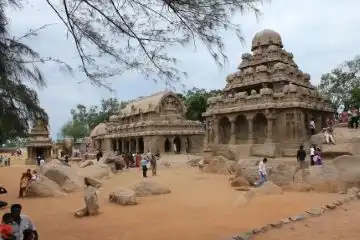
A short walk from Arjuna's Penance leads to the Pancha Rathas. It is a set of five monolithic temples carved from single granite boulders. These do not come among actual temples and monuments in Mamallapuram used for worship but experimental architectural prototypes. Each crafted in a unique style to represent different forms of Dravidian temple architecture. Named after the Pandavas and their wife Draupadi, these rathas exhibit varied architectural elements such as tiered towers, ornate pillars, and curved roofs. Their geometric harmony and attention to sculptural detail reveal the incredible planning and craftsmanship of Pallava artisans. Although these shrines were never consecrated, they offer a tangible blueprint for many South Indian temples that came later. It make them vital to understanding the evolution of Indian temple design.
Mystique and Physics at Krishna's Butter Ball
One of Mamallapuram's most intriguing attractions is the colossal boulder known as Krishna's Butter Ball. Perched precariously on a slope, this granite rock appears as if it should roll down at any moment, but it has remained unmoved for centuries. Believed to be a divine miracle associated with Lord Krishna's childhood pranks, this natural marvel draws countless curious visitors. Scientists consider it a geological formation, yet its balance and permanence defy easy explanation. Stand beneath this immense rock and contemplate its stubborn defiance of gravity. That adds an element of playful mystery to the otherwise spiritual atmosphere of the site.
The Sacred Stories of the Cave Temples
Scattered across Mamallapuram are several cave temples carved directly into hillocks. These include the Varaha Cave Temple, Mahishasuramardini Cave, and Trimurti Cave. Each adorned with intricate relief sculptures that portray episodes from Hindu mythology. In the Varaha Cave, for instance, visitors can see Lord Vishnu lifting the Earth goddess Bhudevi in his boar incarnation. It symbolizes the victory of good over evil. The Mahishasuramardini Cave features a powerful depiction of Goddess Durga slaying the buffalo demon Mahishasura. The another panel shows Lord Vishnu reclining in cosmic repose. These artistic expressions serve both religious and aesthetic purposes. That allow devotees and travelers alike to engage with mythological stories in an immersive, tactile form.
Reverence at Thirukadalmallai Temple
While many of temples and monuments in Mamallapuram now function primarily as tourist attractions. But, the Thirukadalmallai Temple remains a living center of worship. Dedicated to Lord Vishnu, this temple is one of the 108 Divya Desams revered in Vaishnavism. It was constructed to counter the effects of sea erosion on the other monuments. That demonstrates a practical as well as devotional purpose. With its traditional white gopuram and colorful festivities, the temple offers an authentic glimpse into contemporary Tamil Hindu rituals. Its continued significance ensures that the spiritual traditions of Mamallapuram are not confined to the past but are part of an ongoing cultural continuum.
Panoramas from the Lighthouse and Beyond
Mamallapuram's elevated terrain offers not only temples and sculptures but also sweeping views of the surrounding landscape. The Old Lighthouse, built in the 19th century during British rule, is a popular spot to gain perspective-literally and figuratively. Next to it stands a much older stone structure believed to have been used as a lighthouse by the Pallavas. Climbing to the top provides a panoramic view of the temples, the ocean, and the modern town. This juxtaposition of past and present invites reflection on the continuity of human endeavor, from ancient religious rites to colonial maritime navigation and beyond.
Celebrating Culture Through the Mamallapuram Dance Festival
Every year, the town comes alive with music and movement during the Mamallapuram Dance Festival, held between December and January. Staged against the dramatic backdrop of the Shore Temple, this open-air festival showcases classical Indian dance forms such as Bharatanatyam, Odissi, Kathak, and Kuchipudi. The combination of ancient monuments and traditional performances creates a sensory experience that transcends time. For visitors, this is not just a performance-it is a celebration of living heritage. The festival underscores the fact that the temples and monuments in Mamallapuram are not silent relics. They are enduring spaces where art continues to breathe and evolve.
Travel Tips for a Seamless Visit
To fully appreciate Mamallapuram's treasures, it's best to plan your visit during the cooler months from October to March. The town is well-connected to Chennai, located about 60 kilometers away. That makes it ideal for a day trip or a relaxed weekend getaway. Accommodations range from seaside resorts to budget lodges, catering to various travel preferences. Most monuments are open from sunrise to sunset, and a single entry ticket usually covers access to major sites. Comfortable walking shoes, sun protection, and a reusable water bottle are essential items to carry. Hiring a local guide or using an audio guide can enrich your understanding of the intricate iconography and historical narratives behind each structure.
The Enduring Allure of Mamallapuram
Exploring the temples and monuments in Mamallapuram is more than a sightseeing endeavor. It is a soul-stirring journey through time, art, and devotion. Each sculpture tells a story, each temple echoes a prayer, and each stone holds a fragment of India's ancient spirit. Whether you're a history enthusiast, a spiritual pilgrim, or a curious traveler, Mamallapuram offers layers of experience that deepen with every visit. It is a place where stone transforms into storytelling, and history merges seamlessly with myth. As you leave its shores, you carry not just photographs but also impressions. That linger-of gods carved in granite, of myths etched into rock, and of a heritage that continuously inspiring across generations.